The arab spring was galvanized by the public relam that is the internet, but it's ctalyst was the public square that brought. The digital spaces in which we allow for social movement to convene is directly related to the physical spaces we allow them to happen. The public relam, much like the Greek Agora is not dead. Read the full article here. A compelling case for public space.
Showing posts with label Culture. Show all posts
4.04.2013
James Mollison's Photography
"Photography is a way to experience the world."
James Mollison has the job I want. Travel, document, experience. I love how he uses comparative photography on unlikely subjects to draw a larger story out from a series of photographs i.e. the Ape passport photos. So simple and also fascinating. Check out more of James' work here.
William Gottlieb's Iconic Photos of Jazz Greats
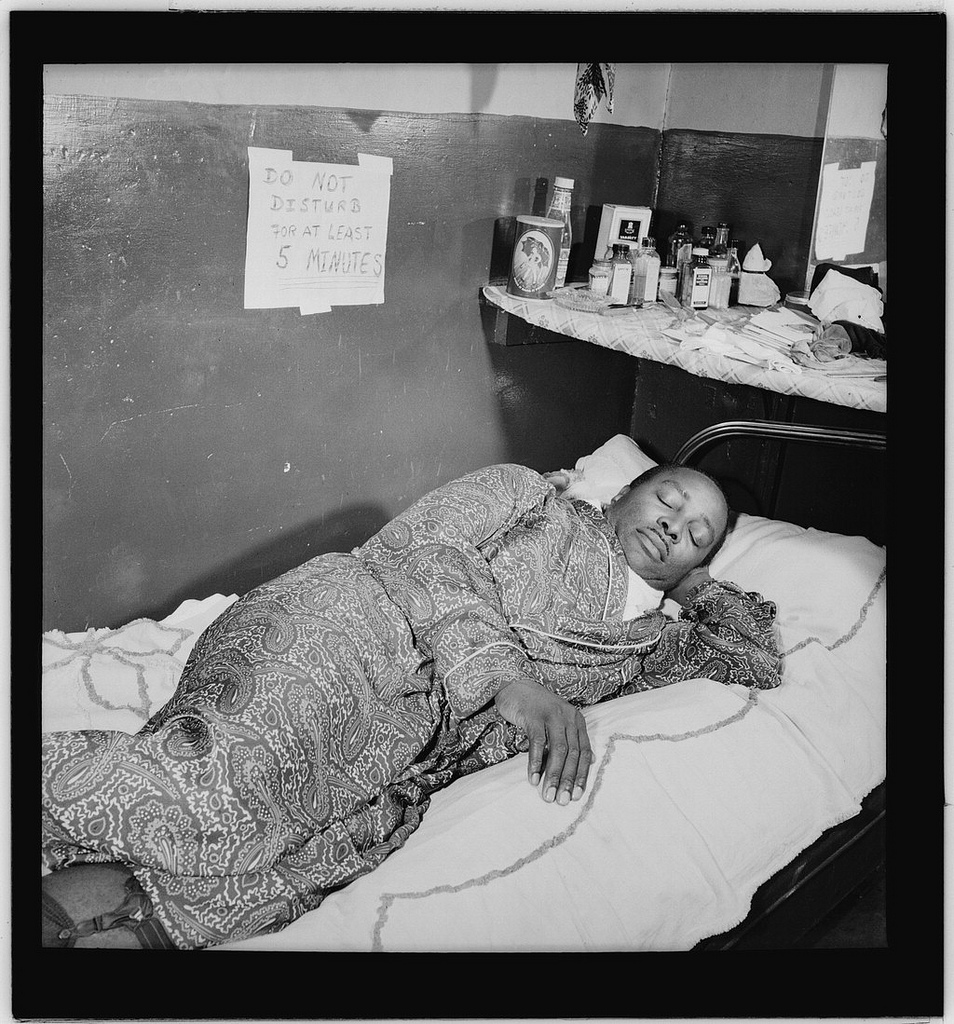
In the 1930s, a young reporter by the name of William Gottlieb set out to cover the boom of the jazz scene for the Washington Post, only to find the paper didn’t care to dispatch an official staff photographer. Gottlieb, a self-taught photographer armed with his Speed Graphic and an ample supply of flashbulbs, took it upon himself to photograph the subjects of his interviews. Between 1938 and 1948, he documented the jazz scene in New York City and Washington, D.C., and created what eventually became some of history’s most iconic portraits of jazz greats. The Golden Age of Jazz gathers 219 of those, including Louis Armstrong, Ella Fitzgerald, Sarah Vaughan (who would have been 88 today), Billie Holiday, and Thelonious Monk, along with original text from the photographer contextualizing the images and their subjects.
Sarah Vaughan, Café Society (Downtown)(?), New York, N.Y., ca. Aug. 1946
Thelonious Monk, Minton's Playhouse, New York, N.Y., ca. Sept. 1947
Billie Holiday, Downbeat, New York, N.Y., ca. Feb. 1947
Joe Thomas, Pied Piper, New York, N.Y., ca. Sept. 1947
Ella Fitzgerald, New York, N.Y., ca. Nov. 1946
Nina Simone performing, Town Hall, N.Y., 1959
Lennie Tristano, New York, N.Y., ca. Aug. 1947
Ernest Tubb, Carnegie Hall, New York, N.Y., Sept. 1947
Charlie Ventura, William P. Gottlieb's home (table tennis room), N.Y., ca. Apr. 1947
Henry Wells, Aquarium, New York, N.Y., ca. Jan. 1947
Josh White and Mary Lou Williams, WMCA, New York, N.Y., ca. Oct. 1947
Cootie Williams, New York, N.Y.(?), between 1938 and 1948
Louis Armstrong, between 1938 and 1948
Tex Beneke, ca. Jan. 1947
Gracie Barry and Dick Stabile, New York, N.Y., between 1946 and 1948
Sy Synclair
Joan Brooks and Duke Niles, New York, N.Y., ca. Apr. 1947
Vivien Garry, New York, N.Y., Dixon's, ca. May 1947
Mary Lou Williams, New York, N.Y., ca. 1946
Dizzy Gillespie, New York, N.Y., ca. May 1947
Buddy Rich, Arcadia Ballroom, New York, N.Y., ca. May 1947
June Christy, 1947 or 1948
Louis Jordan, between 1938 and 1948
William P. Gottlieb, WINX, Washington, D.C., ca. 1940
Mister (Billie Holiday's dog), New York, N.Y., between 1946 and 1948
Afghanistan: March 2013 In Pictures
Afghan President Hamid Karzai spent last weekend in Qatar, speaking with Qatari officials about mediating possible talks with Taliban officials as the 2014 deadline for NATO withdrawal from Afghanistan approaches. Australia announced it will withdraw most troops by the end of this year, closing down at least one major NATO base. Two newly appointed U.S. officials -- Defense Secretary Chuck Hagel and Secretary of State John Kerry -- paid visits to the country last month, making efforts to shore up relations with Karzai, who has been stepping up his criticism of the U.S. and NATO. The photos below are just a glimpse of this conflict over the past month, part of the ongoing series here on Afghanistan. Check out the rest of the stunning images shot by The Atlantic here.
3.31.2013
American Girl in Italy by Ruth Orkin (1951)
The most beautiful photograph... A beautiful woman and the male gaze... Read an American Girl in Italy's backstory here.
3.26.2013
More Vice Docos on Documentary Photography: Saudi Arabian Women Unveiled & Documenting Asia's Illegal Animal Trade
"Photography has been the Best Visa."
Documenting Asia's Illegal Animal Trade - Still usiing analog, I can respect that. Venturing ino the wild to bring to the fore the stories that are worth telling. I can respect that.
Also check out War Photographer below for more on analog development process, start the video at 8.32min - old school photoshop at its best.
Saudi Arabian Women Unveiled - a really really cool photography concept which incorporates art, humanitarianism, photography and technology.
3.25.2013
The Most Detailed Picture of the Internet Ever
Why would you need a map of the Internet? The Internet is not like the Grand Canyon. It is not a destination in a voyage that requires so many right turns and so many left turns. The Internet, as the name suggests and many of you already know, is nothing but the sum of decentralized connections between various interconnected computers that are speaking roughly the same language. To map out those connections and visualize the place where I spend so much of my time may not have any clear use, but it intrigues the pants off me. Read there full article here.
3.24.2013
Giuseppe Tornatore's Malena (2000)
My endless fascination with Italy has only been fuelled by a film I watched a while back. A coming of age story where the protagonist, a pubescent boy named Vito develops an unhealthy crush on the towns beautiful widow, Malena. Through his obsession, he discovers himself, his sexuality, and the cruelties of his own culture. The director, Giuseppe Tornatore is famed for Cinema Paradiso (1988), another coming-of-age tale set in rural 1940s Italy. However, I never felt that the tale was quite as heart felt as this one. Not to mention, Monica Belluci is absolutely revitting as the captivating and enigmatic Malena. And as far as WWII movies go, this hits the top of my list. Beautiful women are always going to be tormented. Their worth and value as a woman living in a misogynistic patriarchal society which views women as sexual objects and encourages women to think of themselves as such. and therefore this other women the green light to treat other women in such a way as well. this is no different in several countries, not least in the progressive ones. We are still very critical of women, not just attractive ones, but smart ones as well. When will the paradigm shift in our global mentalities towards women? Or will we allow these stereotypes to proliferate?
Malena Trailer
Django Django - WOR
Mercury prize nominees Django Django have released the video to their track WOR inconjunction to music channel Noisey, which brought them to Allahabad, India where they documented and created a short film out of the infamous Indian Well Death riders. Speaking about the video, Noisey said: "We happily obliged, getting our shoes stolen in the process, but it was worth it to meet a bunch of guys with the most rock solid testicles we've ever come across." Check it out above.
3D Printed Guns Documentary Trailer
What are the implications for gun culture in America? What power does this technology hold and where will it take us? What kind of world will this manufacture n our future? Home made guns made by children makes violence more tangibly accessible to those unfit to possess a weapon, the laundry list of implications is endless.
3.21.2013
3.20.2013
Seeing Double: What China's Copycat Culture Means for Architecture
An alpine town, the Eiffel Tower, the whole Manhattan skyline … China is replicating the world's architectural gems. But now Zaha Hadid would like it to stop. Read the rest of the article by Oliver Wainwright here.
Now a barbecue restaurant ... Ronchamp in Zhengzhou, 2004.
Le Corbusier's Chapelle de Notre Dame du Haut, Ronchamp, France.
3.19.2013
An Opinion Piece on Gated Communities in South Africa: "This is a village with no facilities beyond raw security"
Dezeen editor-in-chief Marcus Fairs discusses why gated communities are "becoming the default setting in towns and cities around the world" and asks whether it matters who owns the land beneath our feet. Check out the full article here.
Kate Seabrook's Endbahnhof
Urban decay and bratwurst. These are the things that continue to draw artists and photographers alike to Berlin, none more so than Aussie born Kate Seabrook, who has called Berlin her home for just over a year now. The juxtaposition of the old and new Berlin continues to be a source of inspiration for many. The following photoset is a collection from her latest project, Endbahnhof, which is a study of each U-bahn station, each with possessing its own quirky style.
Kate says of her work:
"Endbahnhof is a photographic series documenting Berlin's entire U-bahn system, end to end, one line at a time. The idea for the project was born out of an appreciation of the impressive and varied styles of U-bahn architecture and typography and the reliability of the system to get Berliners where they need to go. What makes Endbahnhof special is that each line is shot in a single journey, disembarking at each station to photograph it before the next train arrives.".
And of the Berlin Public Transportation system, Kate says:
"I have found it very interesting that the architecture of the U-bahn station reflects the local area. Generally speaking, the historical working class and former communist neighbourhoods tend to have stations that are more purist in design, whilst the most elaborate designs can be found in wealthy former West Berlin neighbourhoods such as Wilmersdorf. The thing I really love is that anyone can experience these extremes of architectural design for the cost of a train ticket!".
Amos Chapple's Trip to Iran
Amos Chapple is a travel photographer who made the following pictures over the course of three visits to the Islamic Republic of Iran between December 2011 and January 2013. The New Zealand freelancer said he "was amazed by the difference in western perceptions of the country, and what I saw on the ground... I think because access for journalists is so difficult, people have a skewed image of what Iran is -- the regime actually want to portray the country as a cauldron of anti-western sentiment so they syndicate news footage of chanting nutcases which is happily picked up by overseas networks. For ordinary Iranians though, the government is a constant embarrassment. In the time I spent there I never received anything but goodwill and decency, which stands in clear contrast to my experience in other middle eastern countries. I met an American special forces soldier in Kyrgyzstan last year who said when it comes to the Middle East, America has the wrong friends and the wrong enemies." Below is a selection of Chapple's recent photographs of Iran, captions provided by the photographer.
Palangan Village, in the mountains near the Iraq border. Palangan, illustrative of many of the country's rural settlements, has benefited handsomely from government support. Many villagers are employed in a nearby fish farm, or are paid members of the Basij, whose remit includes prevention of "westoxification", and the preservation of everything the 1979 Islamic revolution and its leader the Ayatollah Khomeini stood for, including strict rules on female clothing and male/female interaction.
A worker inside Vakil Mosque, Shiraz. The mosque now serves as a tourist attraction but sees only a trickle of visitors. Although tourism is on the increase, western tourists still make up only 10% of the total. One tourist guide said westerners are scared away by the bloodcurdling rhetoric of a government which is completely out of touch with ordinary Iranians.
At the Sa'adabad Palace complex in northern Tehran, Islamic revolutionaries sawed a statue of the deposed Shah in half. Today schoolchildren are taken on group visits past the boots and into the palace to see the decadence of the former Shah's living quarters.
Women in the hills above Tehran at dusk. Concealing clothing in the Islamic Republic, including head coverings, is mandatory for women, but the exact definition of "modest" is flexible, leading to a tug of war between young females and the authorities each spring. Outside metro stations female police can be seen regularly checking the passers by. If a woman's dress is considered "immodest" she is arrested and taken into custody. In 2010 a senior cleric in Tehran blamed the frequency of earthquakes in Iran on women who "lead young men astray" with their revealing clothing.
A shepherd leads his flock out to pasture in the mountains on the Iran/Iraq border.
View of central Tehran from inside a minaret in Sepahsalar Mosque.
A young worker walks through the light of a stained glass window in the Tehran Bazaar. Under Khomeini Iranians were actively encouraged to produce large families. By 2009 nearly 70% of all Iranians were under 30, but according to some reports, the country is the least religious in the Middle East. Instead of the "armies for Islam" Khomeini had called for, the youthful population is now seen as the biggest threat to the deeply unpopular regime.
The Mausoleum of Ayatollah Khomeini in Tehran. Work on the unfinished building has dragged over 23 years. With growing economic chaos in the country, its completion is still nowhere in sight.
Detail of Persepolis, the seat of the Ancient Persian empire. The Arab conquest of Persia led to a an Islamification of Iran but Farsi, the Iranian language, has remained alive. The 11th century poet Ferdowsi, described as "Iran's Homer", wrote an epic in Farsi which was carefully crafted with minimal Arabic influence. The "Book of Kings" has been credited with helping preserve the Farsi language - one of the world's oldest. The Book of Kings ends with the Arab invasion, depicted as a disaster for Persia.
Two young twins on the Tehran Metro.
In Tehran, a collection of modern art valued at $2.5 billion is held by the Museum of Contemporary Art. In a little-publicized exhibition in 2011 the works, including pieces by Warhol (pictured), Pollock, Munch, Hockney and Rothko were put on display for the first time since 1979 when the owner of the art, Queen Farah Pahlavi was forced to flee Iran with her husband, the late Shah of Iran.
Detail of Persepolis. After the Islamic Revolution, hardline clerics called for the destruction of the site, but official unease prevailed. "They realized this would unite the people against them," says an English teacher named Ali, quoted in National Geographic.
A mural painted on the wall of the former American embassy in Tehran. Murals such as this are at odds with statistics showing that, despite American sanctions, and the American-led coup against a elected and popular prime minister, more Iranians feel positively about America than do Turks or Indians.
A Kurdish man settles in for a night of guarding some roadworking machinery in the mountains near the Iran/Iraq border. The border is rife with smugglers who carry alcohol from Iraq (where alcohol is legal) into the villages on the Iranian side. From there it is transported by vehicle to the cities. In Tehran a can of beer on the black market fetches around $10 USD.
Two soldiers being attacked inside the Tehran metro after an argument. The soldier was punched in the head at least four times by an angry crowd of mostly well-dressed young men. Both soldiers were forced to leave the metro at the next station.
Azadi ("Freedom") Tower, the gateway to Tehran designed in 1966 by a then 24 year old Hossein Amanat. As a practicing Bahai'i Hossein was forced to flee Iran after the Islamist government labeled followers of the religion "unprotected infidels". He now lives in Canada.
A man in southern Tehran, the working class region of the city. In the past 14 months, tightened sanctions have nearly halved the value of Iran's currency and fueled soaring inflation (source). Life is becoming drastically difficult for ordinary Iranians but many feel powerless to change the situation. Said one Tehrani "we're not naive like the Arabs to think a violent uprising will magically fix everything. We've had our revolution... and things only got worse."
A commemorative plate of the former Shah of Iran in an antique store in Shiraz. The Shah was given an Authoritarian hold on power thanks to an MI6 and CIA-backed coup in 1953 which deposed Prime Minister Mohammad Mosaddegh and cost the lives of several hundreds of Iranian citizens. "Operation Ajax" was actioned after Mosaddegh nationalized the petroleum industry of Iran, thus shutting out British dominance of an industry they had controlled since 1913. That Mosaddeqh had been a democratically-elected leader, with wide popular support fueled resentment at the Shah, who many saw as a brutal puppet for the west. The anger at western intervention stoked strong initial support for the virulently anti-western Ayatollah Khomeini.
Two shepherds lead Palangan's flock of communally-owned sheep out to pasture. The government's spending in some rural regions has bought them a network of loyal followers who can be scrambled at any time to crush trouble in the urban centers. Rural Basij were used as a part of the crackdown in 2009 which resulted in the deaths of seven anti-government protestors.
A group of friends in the hills above Tehran. Many (every single one I met) young Iranians feel deeply embarrassed by their government, and the way the nation is perceived abroad. Zac Clayton, a British cyclist who will finish a round-the-world cycle on March 23 described Iran as having the kindest people of any country he cycled through. "I found most Iranians -- particularly the younger generation -- to be very aware of the world around them... with a burning desire for the freedoms they feel they are being denied by an out of touch, ultra-conservative religious elite."
Subscribe to:
Posts (Atom)


.jpg)