Showing posts with label Documentary. Show all posts

4.04.2013

William Gottlieb's Iconic Photos of Jazz Greats

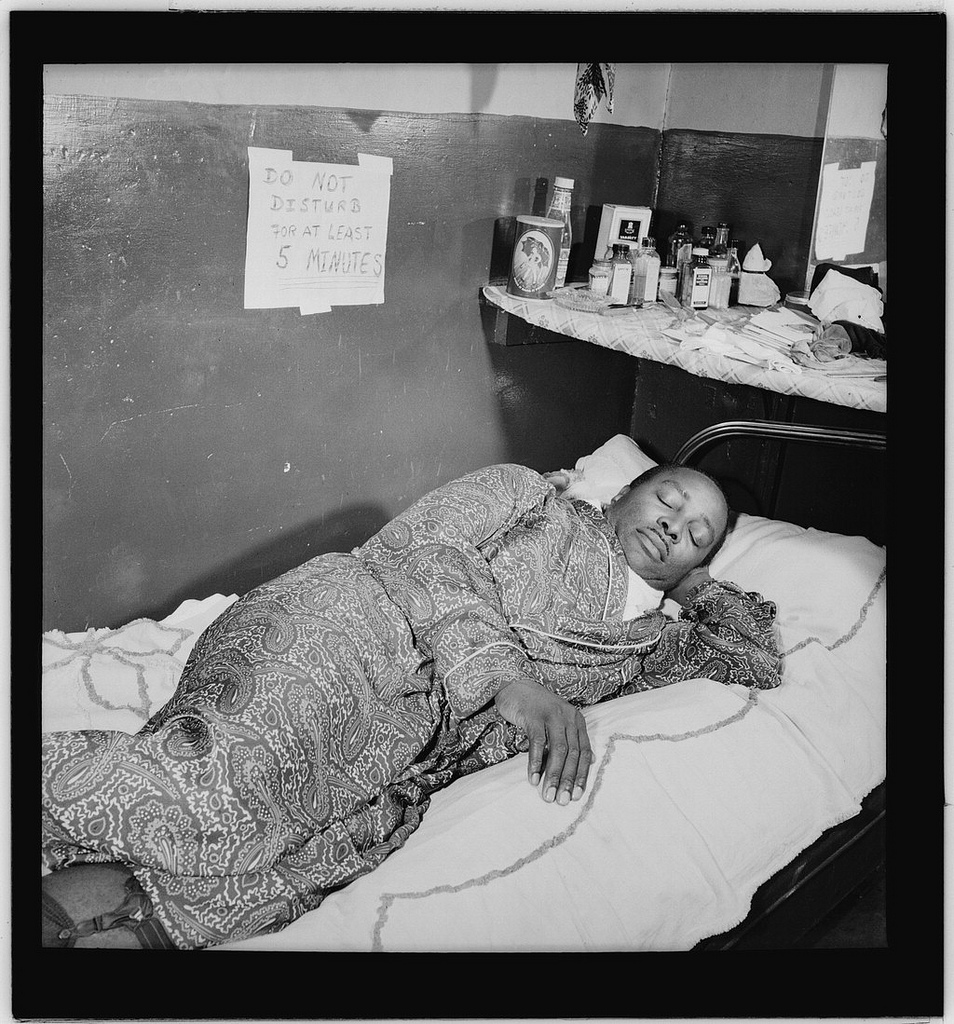
In the 1930s, a young reporter by the name of William Gottlieb set out to cover the boom of the jazz scene for the Washington Post, only to find the paper didn’t care to dispatch an official staff photographer. Gottlieb, a self-taught photographer armed with his Speed Graphic and an ample supply of flashbulbs, took it upon himself to photograph the subjects of his interviews. Between 1938 and 1948, he documented the jazz scene in New York City and Washington, D.C., and created what eventually became some of history’s most iconic portraits of jazz greats. The Golden Age of Jazz gathers 219 of those, including Louis Armstrong, Ella Fitzgerald, Sarah Vaughan (who would have been 88 today), Billie Holiday, and Thelonious Monk, along with original text from the photographer contextualizing the images and their subjects.
 Sarah Vaughan, CafĂ© Society (Downtown)(?), New York, N.Y., ca. Aug. 1946
 Thelonious Monk, Minton's Playhouse, New York, N.Y., ca. Sept. 1947
 Billie Holiday, Downbeat, New York, N.Y., ca. Feb. 1947
 Joe Thomas, Pied Piper, New York, N.Y., ca. Sept. 1947
 Ella Fitzgerald, New York, N.Y., ca. Nov. 1946
 Nina Simone performing, Town Hall, N.Y., 1959
 Lennie Tristano, New York, N.Y., ca. Aug. 1947
 Ernest Tubb, Carnegie Hall, New York, N.Y., Sept. 1947
 Charlie Ventura, William P. Gottlieb's home (table tennis room), N.Y., ca. Apr. 1947
 Henry Wells, Aquarium, New York, N.Y., ca. Jan. 1947
Josh White and Mary Lou Williams, WMCA, New York, N.Y., ca. Oct. 1947
 Cootie Williams, New York, N.Y.(?), between 1938 and 1948
 Louis Armstrong, between 1938 and 1948
 Tex Beneke, ca. Jan. 1947
 Gracie Barry and Dick Stabile, New York, N.Y., between 1946 and 1948
Sy Synclair
 Joan Brooks and Duke Niles, New York, N.Y., ca. Apr. 1947
 Vivien Garry, New York, N.Y., Dixon's, ca. May 1947
 Mary Lou Williams, New York, N.Y., ca. 1946
 Dizzy Gillespie, New York, N.Y., ca. May 1947
 Buddy Rich, Arcadia Ballroom, New York, N.Y., ca. May 1947
 June Christy, 1947 or 1948
 Louis Jordan, between 1938 and 1948
 William P. Gottlieb, WINX, Washington, D.C., ca. 1940
Mister (Billie Holiday's dog), New York, N.Y., between 1946 and 1948

3.31.2013

The Strangers Project

"Everyone has a story - What's yours?" 
In the same vein as Humans of New York, The Strangers Project is a site dedicated to sharing the stories of everyday strangers. The sit offers a series of anonymous journal entries collected from complete strangers. Read their stories here

3.26.2013

More Vice Docos on Documentary Photography: Saudi Arabian Women Unveiled & Documenting Asia's Illegal Animal Trade

"Photography has been the Best Visa."
Documenting Asia's Illegal Animal Trade - Still usiing analog, I can respect that. Venturing ino the wild to bring to the fore the stories that are worth telling. I can respect that. 
Also check out War Photographer below for more on analog development process, start the video at 8.32min - old school photoshop at its best. 
Saudi Arabian Women Unveiled - a really really cool photography concept which incorporates art, humanitarianism, photography and technology.

3.24.2013

Django Django - WOR

Mercury prize nominees Django Django have released the video to their track WOR inconjunction to music channel Noisey, which brought them to Allahabad, India where they documented and created a short film out of the infamous Indian Well Death riders. Speaking about the video, Noisey said: "We happily obliged, getting our shoes stolen in the process, but it was worth it to meet a bunch of guys with the most rock solid testicles we've ever come across." Check it out above.

3D Printed Guns Documentary Trailer

What are the implications for gun culture in America? What power does this technology hold and where will it take us? What kind of world will this manufacture n our future? Home made guns made by children makes violence more tangibly accessible to those unfit to possess a weapon, the laundry list of implications is endless.

3.19.2013

Humans of New York

“I’m attracted to the extreme light and the extreme dark. I’m interested in the human condition and what makes people tick. I’m interested in the things people try to hide.” - Johnny Depp  

Humans of New York is one of the best tumblrs I've stumbled across in a long time. the concept is simple, photographer Brandon Stanton documents the minor accidental encounters that fill ones day,  all of which essentially effect ones perception of a city. "For the past year and two months or so I've been walking all over New York. I've been to almost every single neighborhood. And I've just been stopping strangers on the street and asking them for their photograph," said Stanton. "What I've done is I've plotted them on a map here. And I've organized them by neighborhood. So what you can do is click on a neighborhood and scroll through the faces of the people that live in those neighborhoods," said Stanton. Stanton calls "Humans of New York" a slice of New York City life. He says he loves the art form because you never know who you'll meet or what you'll get, like a break dancer with his son or ballet students. "There's a ton of kids on here. And whenever I see an old couple in love I always stop and ask them for their photograph. Part of that is me knowing what people on my Facebook group like also. We love kids and we love old people in love," said Stanton. Humans of New York is part social documentary, part art project. It offers a dialogue on the existentialism of life, enjoyed through the light-hearted snippets from Brandon's lens. Humans of New York represents everything I love about New York: travel photography and small scale community involvement - this is exactly what the world needs - love, understanding, connecting and documenting. C'est Parfait. I've actually been subscribed to this Tumblr for quite a while, its my little slice of heaven online but I had an overwhelming need to share it here. "I'm always very sensitive as to whether or not I'm getting Jaded." Brandon says, and his introspective outlook and his child like enthusiasm make the blog even more endearing. It seems to me, that by examining other cultural phenomenons like Girls, or the Sartorialist,  people are creating a candid dialogue about what they're going through, documenting and finding solace in the fact that several other people also find solace in the same thing create hime truths. In a way, this made me realize that photography creates an intimacy that cannot be replicated in any other art form, it creates a bond between the photographer and the subject - it's raw, gritty and honest  and presents a fully rendered human being oddly enough... I think that this blog teaches us that we can learn from others, and what we can do about connecting with each other on a small scale makes us realize the fragility of our own existences, which is an important reminder in this fast paced world.

Brandon's Story in his own words...
"Hey there.  I’m Brandon.  I get really passionate about things.  At some time in my life, I’ve been obsessed or borderline-obsessed with saltwater aquariums, the baritone euphonium, reading, piano, filming, financial markets, New York City, and photography.  I studied History at the University of Georgia.  During my senior year of college, I took out $3,000 in student loans and bet it on Barack Obama to win the presidency.  A friend heard about this bet and got me a job trading bonds on the Chicago Board of Trade.  I traded for three years.  It went really well for awhile.  But then it went really bad. Whoops. After I lost my trading job, I decided to move to New York City and take portraits of strangers on the street. Mom wasn’t too happy about that decision, but so far it’s gone pretty well. I’ve taken nearly 5,000 portraits and written 50 stories. And I’ve met some amazing people along the way."

"It's important not to rush through life so much that you don't find time to do the things you really should be doing."
"What things do you wish you'd made more time to do?"
"I wish I'd learned to drive a racecar. Learned to cook. Followed up with a certain young lady. I wish I'd read more. I've got this stack of books I'm going through now, but I should have read them 50 years ago. I'm even reading Harry Potter!"
"Do you mind if I take your photo?"
"..."
"I run a website called...."
"Don't give me that shit line. Just take the picture."
“This is a character.”
“Oh, so this isn’t you?”
“It’s not me. But there’s a lot of me in here.”
“I’m in the middle of a spiritual process. I can’t wear color for another six months.”
“I work at the UN. I study happiness, actually.”
“So what’s happiness then?”
“Well it’s very strongly related to income, but only to a certain amount. After about $20,000 a year, it becomes much more dependent on the amount of time we spend with family and friends. This is something we seem to intuitively know at the beginning and end of our lives— but lose sight of in the middle.” 
“I never had any family growing up. But I still went to school everyday. One day, when I was in eleventh grade, my English teacher came up to me and said: “If you graduate, I’ll adopt you. I’ll show you the life. You’ll do things you never dreamed of.” And he kept his promise. He made it legal and everything. On the day I graduated, he was the only family I had there. My father’s taken me everywhere since then. I’ve done all kinds of things.”
Seen in Times Square.
Seen on the Williamsburg Bridge.
“When my husband was dying, I said: ‘Moe, how am I supposed to live without you?’ He told me: ‘Take the love you have for me and spread it around.’”
Seen on the Subway
“Living in New York is a struggle, because you’re always trying to make $5 last for three days. But in a way it’s romantic, because The City always gives you little ways to make it.”
This man walked onto the subway and announced in a loud voice that “Everyone is now on the Love Train!” He then started blasting gospel music, volume 10. Ironically, some people opposite-of-loved it.

Meanwhile in Iran...
“How is business?”
“As God wants it to be.” 
(Tehran, Iran)
This man offered me a cup of tea after I took his photo. It seemed like a good idea to accept his offer. He was super friendly, but it quickly became apparent that the extent of his English consisted of the phrase: “Do you want some tea?” Unable to communicate, we spent an awkward five minutes staring at our shoes and avoiding eye contact, while I burned the shit out of my tongue trying to finish the tea as fast as possible.
I saw these men from the window of a taxi. I asked the driver to pull over, so I could walk back and take their photo. Instead he INSISTED on backing up against a heavy stream of traffic. It was 100 yards of sheer terror. “No, please,” I said. “This is perfect.” Not a problem at all, he insisted.
So much of Iran’s history, as well as world history, is encapsulated in this image. These are the 200 year old etchings of British servicemen, carved into the 2500 year old walls of Persepolis— the markings of a modern empire on the ruins of an ancient one. The drive to empire is not a disease of individual nations, but a disease of humanity.

Behind the Portraits
A City of Faces
An American Photogrpaher in Iran

Check out Humans of New York here.

3.03.2013

People Who Just Had Sex

Casual conversations about fucking with people who just fucked each other. Vice has cornered the market on realism. I'm a fan. Check out the series here.

The Burned and Bloodied Sex Workers of Southern Mumbai

An estimated 100,000 sex workers currently earn a living working in the brothels of South Mumbai’s red-light districts. Most of them are not there voluntarily, but rather, have been sold into sex work, sometimes by a relative or trusted family friend. Some are born into it. Life within the red-light districts isn't easy. In fact, it's pretty much like living in a giant toilet bowl full of syringes and awful people. These women live on the fringes of a society defined by the unrelenting harshness of its edges. They are frowned upon and ignored.

I began my photo essay on a group of sex workers based in the red-light districts of Kamathipura, Falkland Road, and Worli. The prostitutes work with Social Activities Integration (SAI), a small NGO modeled on the Didi ("Sister") Project. These women take what they learn about HIV, STDs, and women's rights back to their communities and teach others about the importance of condoms and HIV testing, giving them a sense of purpose and self-respect—in addition to helping them reduce the risk of sexual disease.

After getting to know some of the women, I felt the need to make my project more personal, in order to tell their stories. Obviously, each of them was a sister, a mother, or a daughter, not just a sex worker. I looked to create images of intimacy, femininity, and tenderness that would contrast with the often brutal reality of their lives. I wanted the viewer to gain insight into the lives of these women. This set of photographs is a selection focusing on violence against these women, taken from my project ,The Sisters of Kamathipura.

The women the project focuses on include Hajra, who is HIV-positive and severely scarred after being set on fire with a kerosene lamp. She is generous, determined, and has an amazing sense of humor. There is also Jyoti, who is 19 and lives in her mother’s brothel. She would have liked to be a policewoman so that she could help women like her sister and mother, but she did not finish her education. Like most teenagers, Jyoti loves music and makeup. Salma and Sony both have young daughters. In a perfect world, Sony would be a Bollywood actress; Salma’s only dream is to keep her daughter safe.

Mumtaz, 35, was a mother and grandmother, and loved her work as a Peer Educator. Mumtaz died from septicemia after being covered in kerosene and set aflame, suffering burns on 85 percent of her body. The police report states the cause of death as suicide, but her family adamantly believes that she was murdered by her partner. Her family asked me to photograph the funeral rites, holding nothing back, as they want the world to know what happened to her.

The premature deaths of sex workers in India is an all too common occurrence. Sex workers continue to live in squalid conditions, isolated from the rest of society, trapped in a life of poverty and, often, slavery, from which there isn't really an escape. Official stats regarding violence against India's female sex workers are nonexistent, as incidents are rarely reported to the authorities, and when they are, very little is done.
 Hajra, Mumtaz, and Sheinaz take a break from fieldwork in a red-light district in Solapur, South Maharashtra. The three women work as peer educators with SAI, an NGO based in Mumbai.
 A customer at the brothel in 14th Lane, Kamathipura. Many of the clients have problems with drugs and alcohol, which can make them violent.
 Hajra is covered in scars from being beaten, tortured, and burned, with both cigarettes and kerosene. Shown here are burns from a previous partner who set her aflame in front of her two children. She was forced to jump from a first-floor window to escape.
 Gambling, a nightly ritual in the red-light districts of Mumbai, along with drinking and drug use—14th Lane, Kamathipura.
 Hajra and Sheinaz live in the same room and work in the same brothel. Many of the women look out for each other.
 Shaila and her young son are terrified as Shaila's pimp has found her after she ran away and is taking her back to her previous brothel where she was constantly beaten and abused.
 The threat of violence is always in the air.
 Not long after this image was taken Salma was badly beaten by her partner, who is also her pimp, for arriving home late. Salma has been beaten and sold into various brothels in three different cities.
 Sony used to dance in a bar until it was closed down. She now works in a hotel, standing on a stage with other girls until a client chooses her.
 Seven-year-old Laxmi stands in front of the room she shares with her mother Sangita in a brothel on Hauman Galli. The room is also her mother's place of work.
  Hajra waits with family and friends outside the trauma care unit of a Mumbai hospital for news of Mumtaz, who was admitted with burns to 85 percent of her body after being set on fire.
 Family members have to hold Durga, 23, Mumtaz's eldest daughter back as she tries to throw herself upon her mother's body. Durga is a widow and has two children of her own.
Mumtaz, 35, died from septicemia after having been covered in kerosene and set aflame. The police report states the cause of death as suicide, but her family believe she was murdered by her partner.
 Mumtaz's sister and eldest daughters wait outside the funeral ground while her body is cremated. Her 18-year-old daughter was getting married as her mother was admitted to hospital.
Mumtaz's body is prepared for cremation in accordance with traditional Hindu customs and beliefs.
 Mumtaz's relatives grieve for her as her body is cremated.
 Violence against sex workers in India is a huge problem. However, the official statistics are unknown as incidents are rarely reported to the authorities, and when they are, very little is done.

The following trailer might also spark your interest:
Born into Brothels (2004)