Showing posts with label Musings. Show all posts

3.31.2013

How to Find Your Purpose and do what You Love

“Find something more important than you are, and dedicate your life to it.” 
Philosopher Dan Dennett once said, But how, exactly, do we find that? Precisely how you arrive at your true calling is an intricate and highly individual dance of discovery. Still, there are certain factors — certain choices — that make it easier. Gathered here are insights from seven thinkers who have contemplated the art-science of making your life’s calling a living.

What is Love? Words of Wisdom from 200 Years of Literary History

C. S. Lewis, who was a very wise man, in The Four Loves:
"There is no safe investment. To love at all is to be vulnerable. Love anything, and your heart will certainly be wrung and possibly be broken. If you want to make sure of keeping it intact, you must give your heart to no one, not even to an animal. Wrap it carefully round with hobbies and little luxuries; avoid all entanglements; lock it up safe in the casket or coffin of your selfishness. But in that casket — safe, dark, motionless, airless – it will change. It will not be broken; it will become unbreakable, impenetrable, irredeemable. The alternative to tragedy, or at least to the risk of tragedy, is damnation. The only place outside Heaven where you can be perfectly safe from all the dangers and perturbations of love is Hell."

Katharine Hepburn in Me : Stories of My Life:
"Love has nothing to do with what you are expecting to get — only with what you are expecting to give — which is everything."

Philosopher and mathematician Bertrand Russell, he of great wisdom, in The Conquest of Happiness:
"Of all forms of caution, caution in love is perhaps the most fatal to true happiness."


Honoré de Balzac, who knew a thing or two about all-consuming love, in Physiologie Du Mariage:
"The more one judges, the less one loves."

3.20.2013

Musings by Paulo Coelho

"Life has many ways of testing a person's will, either by having nothing happen at all or by having everything happen all at once." - Paulo Coelho

3.05.2013

How to Think More about Sex by Alain de Botton

“The more closely we analyze what we consider ‘sexy,’ the more clearly we will understand that eroticism is the feeling of excitement we experience at finding another human being who shares our values and our sense of the meaning of existence.”
...
“When we hook up with another, in sex or love (or, more rarely, both) we prove that our isolation is not permanent,” - Dorion Sagan 

And yet that very quest to end our isolation has been subject to centuries of stigma and incessant friction with our social values. But it needn’t be this way. We are guided through the perils this sexual conundrum by philosopher Alain de Botton.

De Botton writes in the introduction:

"Despite our best efforts to clean it of its peculiarities, sex will never be either simple or nice in the ways we might like it to be. It is not fundamentally democratic or kind; it is bound up with cruelty, transgression and the desire for subjugation and humiliation. It refuses to sit neatly on top of love, as it should. Tame it though we may try, sex has a recurring tendency to wreak havoc across our lives: it leads us to destroy our relationships, threatens our productivity and compels us to stay up too late in nightclubs talking to people whom we don’t like but whose exposed midriffs we nevertheless strongly wish to touch. Sex remains in absurd, and perhaps irreconcilable, conflict with some of our highest commitments and values. Unsurprisingly, we have no option but to repress its demands most of the time. We should accept sex as inherently rather weird instead of blaming ourselves for not responding in more normal ways to its confusing impulses."

"This is not to say that we cannot take steps to grow wiser about sex. We should simply realize that we will never entirely surmount the difficulties it throws our way. Our best hope should be a respectful accommodation with an anarchic and reckless power."

He later offers a delightfully animated account, of why a kiss holds the appeal that it does:

"The pleasure of the moment can be understood only by considering its wider context: the overwhelming indifference against which any kiss is set. It goes almost without saying that the majority of people we encounter will be not merely uninterested in having sex with us but positively revolted by the idea. We have no choice but to keep a minimum of sixty or, even better, ninety centimeters’ distance between us and them at all times, to make it absolutely clear that our compromised selves have no intention of intruding into their personal spheres.

Then comes the kiss. The deeply private realm of the mouth — that dark, moist cavity that no one else but our dentist usually enters, where our tongue reigns supreme over a microcosm as silent and unknown as the belly of a whale — now prepares to open itself up to another. The tongue, which has had no expectation of ever meeting a compatriot, gingerly approaches a fellow member of its species, advancing with something of the reserve and curiosity exhibited by a South Sea Islander in greeting the arrival of the first European adventurer. Indentations and plateaus in the inner lining of the cheeks, hitherto thought of as solely personal, are revealed as having counterparts. The tongues engage each other in a tentative dance. …

Beneath the kiss itself, it is its meaning that interests us — which is why the desire to kiss someone can be decisively reduced… by a declaration of that desire — a confession which may in itself be so erotic as to render the actual kiss superfluous."

But the true mesmerism of sex, de Botton argues, isn’t even in the physical act itself — it’s in the existential promise that it holds:

"The pleasure we derive from sex is also bound up with our recognizing, and giving a distinctive seal of approval to, those ingredients of a good life whose presence we have detected in another person. The more closely we analyze what we consider ‘sexy,’ the more clearly we will understand that eroticism is the feeling of excitement we experience at finding another human being who shares our values and our sense of the meaning of existence.

Our culture encourages us to acknowledge very little of who we normally are in the act of sex. It seems as if it might be a purely physical process, without any psychological importance. But … what happens in love-making is closely bound up with some of our most central ambitions. The act of sex plays out through the rubbing together of organs, but our excitement is no boorish physiological reaction; rather, it is an ecstasy we feel at encountering someone who may be able to put to rest certain of our greatest fears, and with whom we may hope to build a shared life based upon common values."

Ultimately, sex is a grounding mechanism that reminds us of our own imperfect humanity, and in that imperfection lies the messy richness of being human:

"Without sex, we would be dangerously invulnerable. We might believe we were not ridiculous. We wouldn’t know rejection and humiliation so intimately. We could age respectably, get used to our privileges and think we understood what was going on. We might disappear into numbers and words alone. It is sex that creates a necessary havoc in the ordinary hierarchies of power, status, money and intelligence.

[…]

We might even embrace the pain sex causes us, for without it we wouldn’t know art and music quite so well. … When every contemptuous but fair thing has been said about our infernal sexual desires, we can still celebrate them for not allowing us to forget for more than a few days at a time what is really involved in living an embodied, chemical and largely insane human life."

3.04.2013

"Self-Reflection" by Carl Jung - Death Is Not the End

Jung Supposes tat we don't subscribe to thinking of the end, or the end result, but rather to look forward, becuse when we look forward we can gain perspective of what we want, not what we lost. If we dont look back and we can be happy - to carry on because its not the end of the world, all that's needed is a change of mind set. After all, life is all about adapting and being proactive, and so is art, so as my commitment to being an artist, and not wanting to purger that commitment, I, like many others, need to pay more attention to the present. It's not what you do for a living that makes or defines you, nor is it your friends or the scene you run in,  or your hobbies... So, what defines YOU? In a way, we can cheat death by being honest to who we are in the present. In essence, that is the force field of life.

2.27.2013

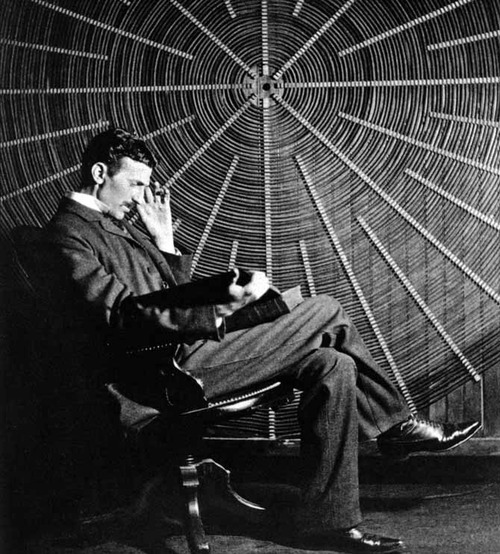
Musings from Nikola Tesla

"I do not think there is any thrill that can go through the human heart like that felt by the inventor as he sees some creation of the brain unfolding to success. Such emotions make a man forget food, sleep, friends, love, everything." - Nikola Tesla

2.26.2013

On Beauty, Quality, Poetry and Integrity: AnaĂ¯s Nin meets Frank Lloyd Wright Jr (1947)

“His struggle is against uniformity and wholesale design. If he sounds like a moralist, it is because beauty, quality, and ethics are inseparable.”
Progression fof the Hollywood Bowl Shell 1926-1929

Among the richest and most rewarding parts of AnaĂ¯s Nin’s diaries is her encounter with Frank Lloyd Wright, Jr., son of the great Frank Lloyd Wright, Though Lloyd Wright, as he was better known, remained in many ways in the inescapable shadow of his father’s legend, he was himself a highly accomplished and visionary architect.
In 1926, a group known as the Allied Architects was commissioned to rebuild the iconic Hollywood Bowl, originally constructed in 1922, but their improvements failed to accommodate sufficient seating or improve the acoustics. In 1927, Wright designed what’s commonly considered the best shell the Hollywood Bowl has ever had, acoustically speaking — a pyramidal structure that was, sadly, deemed too avant-garde by the powers that be and was subsequently demolished after just one season. The following year, Wright was granted a redo and he designed a collapsible, concentric fiberglass shell with movable panels inside for tuning the acoustics — but that, too, was buried for political reasons. The Allied Architects took over for the 1929 season and built the structure that endured, with cosmetic modifications (including, most famously, one by Frank Gehry in 1982), until 2003. It was that “monstrously ugly” version that stood when Nin met Wright in 1947. While the Hollywood Bowl is but a passing mention in their encounter, Nin’s extraordinary insight into Wright’s ethos becomes, as so much of her writing does, a springboard for a larger meditation on architecture, the world of art and role of the artist, and the ideological underpinnings of mid-century American culture.

"I saw his plans for Los Angeles. It could have been the most beautiful city in the world, for everyone to come to see, as people went to see Venice. But architecture had been taken over by businessmen, and Lloyd the artist was not allowed to carry out his incredibly rich, fecund concepts. The room was full of them. When he took a rolled-up drawing from the shelves and spread it over the table, I saw buildings which equaled the wonders of the past.

[…]

Strength was obvious in him, but sensitivity and imagination were in his drawings. Homes, churches, plans for entire cities. A universe of lyrical beauty in total opposition to the sterile, monotonous, unimaginative ‘box’-buildings now seen all over the world.

[…]

I expected Los Angeles to be filled with his buildings. This was not the case. Fame highlighted his father’s work, but not Lloyd’s—not as he deserved. If his plans had been carried out, the world would have been dazzled by them. His work was on a scale which should have appealed to the spirit of grandeur in the American character, a dramatic and striking expression of a new land. But instead, American architects chose to take the path of imitating Europe, of uniformity, monotony, dullness. In Lloyd’s work there was space, invention, poetry, a restrained and effective use of the romantic, surprises always in the forms, new and imaginative use of structural parts, rooms, windows, and materials. He has a gift for involvement in many-leveled lives, for the variations, caprices, and nuances necessary to the human spirit. Every stone, every roof-tile, every window, every texture or material was designed for the consistent development of his building, its environment, and designed to elevate the quality of people’s lives. Uniformity and monotony kill individuality, dull the senses. Lloyd designed his work to reinforce individuality with poetry, beauty, and integrity. It was planned to create a more beautiful and satisfying human environment. Architecture as poetry. … By contrast, the commonplace, shoddy, temporary movie-set houses around him were painful to see. He called them ‘cracker boxes,’ shabby, thin, motel-type homes for robots.

[…]

The Wright pride. Yes, pride in quality. He supervises his buildings, takes care of every detail: searches for masons who care about stonework, painters who can paint, metalworkers who are skillful. Today, in an age of amateurs, this is a most difficult achievement.

[…]

His struggle is against uniformity and wholesale design. He speaks out boldly, as Varèse did. If he sounds like a moralist, it is because beauty, quality, and ethics are inseparable. Beauty and integrity. And for them one has to be willing to make sacrifices.

[…] 

This architect never falls off the high standards, the heights he established for himself. The mediocre and the deformed sprout around him, like weeds, ugly buildings which do not endure and which look shabby after a few months. He is offended, but he does not surrender. He finds it “futile, offensive, and all-pervasive, but not inevitable."
In one of her visits, Nin has a chance to look through Wright’s notes and comments on architecture, where she finds the following telling micro-manifesto.

"I am concerned with our natural environment, how we can discover and utilize form, and perfect the endlessly varied, stimulating and beautiful services it provides for mankind. It is the architect’s opportunity and responsibility to understand and practice the art of creating with and out of them a suitable environment for mankind—advancing the art with every conceivable means, including, among others, poetic license and poetic prescience. And now, after billions of years of experience and preconditioning on this earth (from the development of the first one-celled amoeba to our present human complex) we have no valid excuse for not performing superbly."

AnaĂ¯s Nin: Emotional Excess is Essential to Creativity

Excerpt from the Diary of AnaĂ¯s Nin:

"I like to live always at the beginnings of life, not at their end. We all lose some of our faith under the oppression of mad leaders, insane history, pathologic cruelties of daily life. I am by nature always beginning and believing and so I find your company more fruitful than that of, say, Edmund Wilson, who asserts his opinions, beliefs, and knowledge as the ultimate verity. Older people fall into rigid patterns. Curiosity, risk, exploration are forgotten by them. You have not yet discovered that you have a lot to give, and that the more you give the more riches you will find in yourself. It amazed me that you felt that each time you write a story you gave away one of your dreams and you felt the poorer for it. But then you have not thought that this dream is planted in others, others begin to live it too, it is shared, it is the beginning of friendship and love.

[…]

You must not fear, hold back, count or be a miser with your thoughts and feelings. It is also true that creation comes from an overflow, so you have to learn to intake, to imbibe, to nourish yourself and not be afraid of fullness. The fullness is like a tidal wave which then carries you, sweeps you into experience and into writing. Permit yourself to flow and overflow, allow for the rise in temperature, all the expansions and intensifications. Something is always born of excess: great art was born of great terrors, great loneliness, great inhibitions, instabilities, and it always balances them. If it seems to you that I move in a world of certitudes, you, par contre, must benefit from the great privilege of youth, which is that you move in a world of mysteries. But both must be ruled by faith."

2.25.2013

Ray Bradbury's Words of Wisdom

Too much time is wasted mulling over what I should and shouldn't do, over-thinking what could happen and the pros and cons instead of taking action, when in fact the only way to know is to experience - no fear. 

2.13.2013

Anyone Seen Jesse and Celeste Forever, Yet?

Jesse and Celeste Forever Trailer

So I watched Jesse and Celeste Forever the other night. This little known film is totally making waves with me atm. I had a bit of a cry, on a topic I think almost every 20-30 woman coud relate to - losing out on love and being single, still thinking of what you lost with all those people in your past. And the crying isn't because you miss them, but becausse you're pissed at yourself for not wising up earlier about them - if you had tried harder, they could still be here with you and now you're like, FUCK. In the film, there are no bad guys and there are no good guys, it's just life, and sometimes you need to move on, this is what it's about. It's refreshing and raw and I like that, very much. Anyway, Rashida Jones is funny and beautiful and vulnerable and real and the film is equally funny and beautiful and vulnerable and real. Watch it! Every single friend in the movie can be likened to someone in your life - so please, do yourself a favour, grab a box of tissues and watch that movie. It's also hysterical in some parts. So worth it! And all the hipster references wont even phase you, 'cause it's that damn good. 
If you wanna know if a movie is shit or not before you watch it, you can always rely on it's soundtrack for some reassurance, this one is no exception. This one's by Porcelain Raft called 'Drifting In and Out'.

2.12.2013

Audrey's Words of Wisdom


The greatest victory has been to be able to live with myself, to accept my shortcomings… I’m a long way from the human being I’d like to be. But I’ve decided I’m not so bad after all.

– Audrey Hepburn

12.06.2012

Musings: Harvey Milk on Being a Fucking Stupid Coward

"Go after her. Fuck, don’t sit there and wait for her to call, go after her because that’s what you should do if you love someone, don’t wait for them to give you a sign cause it might never come, don’t let people happen to you, don’t let me happen to you, or her, she’s not a fucking television show or tornado. There are people I might have loved had they gotten on the airplane or run down the street after me or called me up drunk at four in the morning because they need to tell me right now and because they cannot regret this and I always thought I’d be the only one doing crazy things for people who would never give enough of a fuck to do it back or to act like idiots or be entirely vulnerable and honest and making someone fall in love with you is easy and flying 3000 miles on four days notice because you can’t just sit there and do nothing and breathe into telephones is not everyone’s idea of love but it is the way I can recognize it because that is what I do. Go scream it and be with her in meaningful ways because that is beautiful and that is generous and that is what loving someone is, that is raw and that is unguarded, and that is all that is worth anything, really."

                        - Harvey Milk


Fuck yes Harvey Milk! Why the fuck can't we all just fucking come clean and say what we want without being deemed an emotional psycho. I'm human, and I'm not going to masquerade around like I don't care, 'cause I do. I feel, I think, maybe too  much at times, but I'm not gonna justify my exploding head and heart in favour of conforming. Sometimes we need to go after what we want, whether it's right or wrong. I think with my head so much, sometimes I want to take my heart out on a walk, get a little air, 'cause I never let it out of it's fucking cage. But as much as I hate it, sometimes life's messy, brutal, awkward , honest, raw and gritty and so are my emotions. Sometimes it needs a little detox so I can go on again. I will not regret telling him how I feel and acting on this impulse because I rarely ever allow myself to, and I'm not gonna apologize for something that's gonna be healthy for me in the long run. I don't wanna be 70 years old and look back on the coulda, woulda, shoulda.