Showing posts with label Inspiration. Show all posts
Showing posts with label Inspiration. Show all posts

3.20.2013
Musings by Paulo Coelho
"Life has many ways of testing a person's will, either by having nothing happen at all or by having everything happen all at once." - Paulo Coelho
3.19.2013
Humans of New York
“I’m attracted to the extreme light and the extreme dark. I’m interested in the human condition and what makes people tick. I’m interested in the things people try to hide.” - Johnny Depp
Humans of New York is one of the best tumblrs I've stumbled across in a long time. the concept is simple, photographer Brandon Stanton documents the minor accidental encounters that fill ones day, all of which essentially effect ones perception of a city. "For the past year and two months or so I've been walking all over New York. I've been to almost every single neighborhood. And I've just been stopping strangers on the street and asking them for their photograph," said Stanton. "What I've done is I've plotted them on a map here. And I've organized them by neighborhood. So what you can do is click on a neighborhood and scroll through the faces of the people that live in those neighborhoods," said Stanton. Stanton calls "Humans of New York" a slice of New York City life. He says he loves the art form because you never know who you'll meet or what you'll get, like a break dancer with his son or ballet students. "There's a ton of kids on here. And whenever I see an old couple in love I always stop and ask them for their photograph. Part of that is me knowing what people on my Facebook group like also. We love kids and we love old people in love," said Stanton. Humans of New York is part social documentary, part art project. It offers a dialogue on the existentialism of life, enjoyed through the light-hearted snippets from Brandon's lens. Humans of New York represents everything I love about New York: travel photography and small scale community involvement - this is exactly what the world needs - love, understanding, connecting and documenting. C'est Parfait. I've actually been subscribed to this Tumblr for quite a while, its my little slice of heaven online but I had an overwhelming need to share it here. "I'm always very sensitive as to whether or not I'm getting Jaded." Brandon says, and his introspective outlook and his child like enthusiasm make the blog even more endearing. It seems to me, that by examining other cultural phenomenons like Girls, or the Sartorialist, people are creating a candid dialogue about what they're going through, documenting and finding solace in the fact that several other people also find solace in the same thing create hime truths. In a way, this made me realize that photography creates an intimacy that cannot be replicated in any other art form, it creates a bond between the photographer and the subject - it's raw, gritty and honest and presents a fully rendered human being oddly enough... I think that this blog teaches us that we can learn from others, and what we can do about connecting with each other on a small scale makes us realize the fragility of our own existences, which is an important reminder in this fast paced world.
Brandon's Story in his own words...
"Hey there. I’m Brandon. I get really passionate about things. At some time in my life, I’ve been obsessed or borderline-obsessed with saltwater aquariums, the baritone euphonium, reading, piano, filming, financial markets, New York City, and photography. I studied History at the University of Georgia. During my senior year of college, I took out $3,000 in student loans and bet it on Barack Obama to win the presidency. A friend heard about this bet and got me a job trading bonds on the Chicago Board of Trade. I traded for three years. It went really well for awhile. But then it went really bad. Whoops. After I lost my trading job, I decided to move to New York City and take portraits of strangers on the street. Mom wasn’t too happy about that decision, but so far it’s gone pretty well. I’ve taken nearly 5,000 portraits and written 50 stories. And I’ve met some amazing people along the way."

"It's important not to rush through life so much that you don't find time to do the things you really should be doing."
"What things do you wish you'd made more time to do?"
"I wish I'd learned to drive a racecar. Learned to cook. Followed up with a certain young lady. I wish I'd read more. I've got this stack of books I'm going through now, but I should have read them 50 years ago. I'm even reading Harry Potter!"

"Do you mind if I take your photo?"
"..."
"I run a website called...."
"Don't give me that shit line. Just take the picture."

“This is a character.”
“Oh, so this isn’t you?”
“It’s not me. But there’s a lot of me in here.”

“I’m in the middle of a spiritual process. I can’t wear color for another six months.”

“I work at the UN. I study happiness, actually.”
“So what’s happiness then?”
“Well it’s very strongly related to income, but only to a certain amount. After about $20,000 a year, it becomes much more dependent on the amount of time we spend with family and friends. This is something we seem to intuitively know at the beginning and end of our lives— but lose sight of in the middle.”

“I never had any family growing up. But I still went to school everyday. One day, when I was in eleventh grade, my English teacher came up to me and said: “If you graduate, I’ll adopt you. I’ll show you the life. You’ll do things you never dreamed of.” And he kept his promise. He made it legal and everything. On the day I graduated, he was the only family I had there. My father’s taken me everywhere since then. I’ve done all kinds of things.”

Seen in Times Square.

Seen on the Williamsburg Bridge.

“When my husband was dying, I said: ‘Moe, how am I supposed to live without you?’ He told me: ‘Take the love you have for me and spread it around.’”

Seen on the Subway

“Living in New York is a struggle, because you’re always trying to make $5 last for three days. But in a way it’s romantic, because The City always gives you little ways to make it.”
.jpg)
This man walked onto the subway and announced in a loud voice that “Everyone is now on the Love Train!” He then started blasting gospel music, volume 10. Ironically, some people opposite-of-loved it.
Meanwhile in Iran...

“How is business?”
“As God wants it to be.”
(Tehran, Iran)

This man offered me a cup of tea after I took his photo. It seemed like a good idea to accept his offer. He was super friendly, but it quickly became apparent that the extent of his English consisted of the phrase: “Do you want some tea?” Unable to communicate, we spent an awkward five minutes staring at our shoes and avoiding eye contact, while I burned the shit out of my tongue trying to finish the tea as fast as possible.

I saw these men from the window of a taxi. I asked the driver to pull over, so I could walk back and take their photo. Instead he INSISTED on backing up against a heavy stream of traffic. It was 100 yards of sheer terror. “No, please,” I said. “This is perfect.” Not a problem at all, he insisted.

So much of Iran’s history, as well as world history, is encapsulated in this image. These are the 200 year old etchings of British servicemen, carved into the 2500 year old walls of Persepolis— the markings of a modern empire on the ruins of an ancient one. The drive to empire is not a disease of individual nations, but a disease of humanity.
Behind the Portraits
A City of Faces
An American Photogrpaher in Iran
Check out Humans of New York here.
3.12.2013
Louis Armstrong Interviewed by Ralph Gleason for Jazz Casual c.1963
0.00 - 0.38: It's heaven how he looks back on his life with such pleasure and nostalgia.
3.06.2013
Manhattan Opening Scene
From Woody Allen's 1979 cinematic masterpiece. Allen undoubtedly has an obsession with the cities, constantly using them as muses, with New York, Paris, Barcelona and Rome all giving colour to his storylines respectfully. And he always comes back to New York. This is his ode to his soulmate: Manhattan
3.04.2013
Photographing Mexico's Cholombiano Street Culture
Inspiring, that this man took the context of social documentary and flipped it on its head by creating an almost pseudo-artificial scene from realism through studio-like ilghting and saturated colours. Almost reminiscent of the Stepford wife images from the 50s. An interesting take. Inspires me to get off my butt and brush up on my technical knowledge.
3.03.2013
2.27.2013
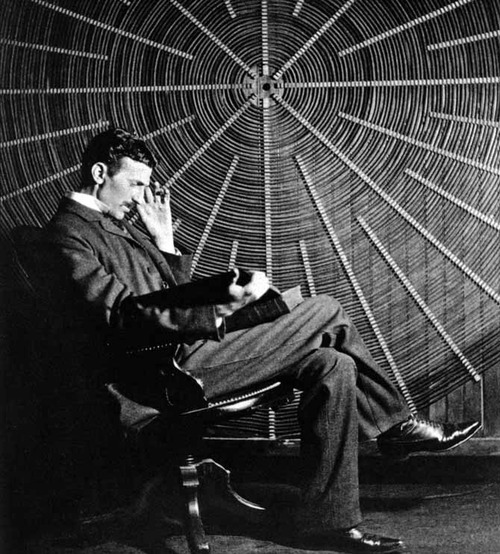
Musings from Nikola Tesla
"I do not think there is any thrill that can go through the human heart like that felt by the inventor as he sees some creation of the brain unfolding to success. Such emotions make a man forget food, sleep, friends, love, everything." - Nikola Tesla
Natalie Portman Shaves her Head in V for Vendetta
If you're gonna cut all your hair off, this is how it should be done: Quick and Painful. Natalie is such a badass. She said of the expereince that she didn't really mind, she had one chance to film this, so obviously she felt the pressure to perform. I always wanted to shave my head, but always backed out because I'll never, ever look like Nat Portman in this or any other life. Also, my head shape is ridiculous.
2.26.2013
Michel Gondry's Mood Indigo
"Mood Indigo," Michel Gondry's new offering, based on Boris Vian's 1947 novel "L'Ecume des Jours" (English translation: "The Froth of Daydreams") has just released a French-language full-length trailer. In the film, a woman (Audrey Tautou) encounters a strange illness due to a water lily growing in her lungs. All this comes after falling in love and marrying a wealthy inventor (Romain Duris). Michel Gondry territory, indeed. Omar Sy ("The Intouchables") also stars. Loved Sy in the Intouchables, Romain Duris is magic in almost all his roles, and Audrey, well if she isn't the definition of elegant, I don't know what is. Ah, gonna go watch the trailer to 2006's Science of Sleep now.
On Beauty, Quality, Poetry and Integrity: Anaïs Nin meets Frank Lloyd Wright Jr (1947)
“His struggle is against uniformity and wholesale design. If he sounds like a moralist, it is because beauty, quality, and ethics are inseparable.”

Progression fof the Hollywood Bowl Shell 1926-1929
Among the richest and most rewarding parts of Anaïs Nin’s diaries is her encounter with Frank Lloyd Wright, Jr., son of the great Frank Lloyd Wright, Though Lloyd Wright, as he was better known, remained in many ways in the inescapable shadow of his father’s legend, he was himself a highly accomplished and visionary architect.
In 1926, a group known as the Allied Architects was commissioned to rebuild the iconic Hollywood Bowl, originally constructed in 1922, but their improvements failed to accommodate sufficient seating or improve the acoustics. In 1927, Wright designed what’s commonly considered the best shell the Hollywood Bowl has ever had, acoustically speaking — a pyramidal structure that was, sadly, deemed too avant-garde by the powers that be and was subsequently demolished after just one season. The following year, Wright was granted a redo and he designed a collapsible, concentric fiberglass shell with movable panels inside for tuning the acoustics — but that, too, was buried for political reasons. The Allied Architects took over for the 1929 season and built the structure that endured, with cosmetic modifications (including, most famously, one by Frank Gehry in 1982), until 2003. It was that “monstrously ugly” version that stood when Nin met Wright in 1947. While the Hollywood Bowl is but a passing mention in their encounter, Nin’s extraordinary insight into Wright’s ethos becomes, as so much of her writing does, a springboard for a larger meditation on architecture, the world of art and role of the artist, and the ideological underpinnings of mid-century American culture.
"I saw his plans for Los Angeles. It could have been the most beautiful city in the world, for everyone to come to see, as people went to see Venice. But architecture had been taken over by businessmen, and Lloyd the artist was not allowed to carry out his incredibly rich, fecund concepts. The room was full of them. When he took a rolled-up drawing from the shelves and spread it over the table, I saw buildings which equaled the wonders of the past.
[…]
Strength was obvious in him, but sensitivity and imagination were in his drawings. Homes, churches, plans for entire cities. A universe of lyrical beauty in total opposition to the sterile, monotonous, unimaginative ‘box’-buildings now seen all over the world.
[…]
I expected Los Angeles to be filled with his buildings. This was not the case. Fame highlighted his father’s work, but not Lloyd’s—not as he deserved. If his plans had been carried out, the world would have been dazzled by them. His work was on a scale which should have appealed to the spirit of grandeur in the American character, a dramatic and striking expression of a new land. But instead, American architects chose to take the path of imitating Europe, of uniformity, monotony, dullness. In Lloyd’s work there was space, invention, poetry, a restrained and effective use of the romantic, surprises always in the forms, new and imaginative use of structural parts, rooms, windows, and materials. He has a gift for involvement in many-leveled lives, for the variations, caprices, and nuances necessary to the human spirit. Every stone, every roof-tile, every window, every texture or material was designed for the consistent development of his building, its environment, and designed to elevate the quality of people’s lives. Uniformity and monotony kill individuality, dull the senses. Lloyd designed his work to reinforce individuality with poetry, beauty, and integrity. It was planned to create a more beautiful and satisfying human environment. Architecture as poetry. … By contrast, the commonplace, shoddy, temporary movie-set houses around him were painful to see. He called them ‘cracker boxes,’ shabby, thin, motel-type homes for robots.
[…]
The Wright pride. Yes, pride in quality. He supervises his buildings, takes care of every detail: searches for masons who care about stonework, painters who can paint, metalworkers who are skillful. Today, in an age of amateurs, this is a most difficult achievement.
[…]
His struggle is against uniformity and wholesale design. He speaks out boldly, as Varèse did. If he sounds like a moralist, it is because beauty, quality, and ethics are inseparable. Beauty and integrity. And for them one has to be willing to make sacrifices.
[…]
This architect never falls off the high standards, the heights he established for himself. The mediocre and the deformed sprout around him, like weeds, ugly buildings which do not endure and which look shabby after a few months. He is offended, but he does not surrender. He finds it “futile, offensive, and all-pervasive, but not inevitable."
"I saw his plans for Los Angeles. It could have been the most beautiful city in the world, for everyone to come to see, as people went to see Venice. But architecture had been taken over by businessmen, and Lloyd the artist was not allowed to carry out his incredibly rich, fecund concepts. The room was full of them. When he took a rolled-up drawing from the shelves and spread it over the table, I saw buildings which equaled the wonders of the past.
[…]
Strength was obvious in him, but sensitivity and imagination were in his drawings. Homes, churches, plans for entire cities. A universe of lyrical beauty in total opposition to the sterile, monotonous, unimaginative ‘box’-buildings now seen all over the world.
[…]
I expected Los Angeles to be filled with his buildings. This was not the case. Fame highlighted his father’s work, but not Lloyd’s—not as he deserved. If his plans had been carried out, the world would have been dazzled by them. His work was on a scale which should have appealed to the spirit of grandeur in the American character, a dramatic and striking expression of a new land. But instead, American architects chose to take the path of imitating Europe, of uniformity, monotony, dullness. In Lloyd’s work there was space, invention, poetry, a restrained and effective use of the romantic, surprises always in the forms, new and imaginative use of structural parts, rooms, windows, and materials. He has a gift for involvement in many-leveled lives, for the variations, caprices, and nuances necessary to the human spirit. Every stone, every roof-tile, every window, every texture or material was designed for the consistent development of his building, its environment, and designed to elevate the quality of people’s lives. Uniformity and monotony kill individuality, dull the senses. Lloyd designed his work to reinforce individuality with poetry, beauty, and integrity. It was planned to create a more beautiful and satisfying human environment. Architecture as poetry. … By contrast, the commonplace, shoddy, temporary movie-set houses around him were painful to see. He called them ‘cracker boxes,’ shabby, thin, motel-type homes for robots.
[…]
The Wright pride. Yes, pride in quality. He supervises his buildings, takes care of every detail: searches for masons who care about stonework, painters who can paint, metalworkers who are skillful. Today, in an age of amateurs, this is a most difficult achievement.
[…]
His struggle is against uniformity and wholesale design. He speaks out boldly, as Varèse did. If he sounds like a moralist, it is because beauty, quality, and ethics are inseparable. Beauty and integrity. And for them one has to be willing to make sacrifices.
[…]
This architect never falls off the high standards, the heights he established for himself. The mediocre and the deformed sprout around him, like weeds, ugly buildings which do not endure and which look shabby after a few months. He is offended, but he does not surrender. He finds it “futile, offensive, and all-pervasive, but not inevitable."
In one of her visits, Nin has a chance to look through Wright’s notes and comments on architecture, where she finds the following telling micro-manifesto.
"I am concerned with our natural environment, how we can discover and utilize form, and perfect the endlessly varied, stimulating and beautiful services it provides for mankind. It is the architect’s opportunity and responsibility to understand and practice the art of creating with and out of them a suitable environment for mankind—advancing the art with every conceivable means, including, among others, poetic license and poetic prescience. And now, after billions of years of experience and preconditioning on this earth (from the development of the first one-celled amoeba to our present human complex) we have no valid excuse for not performing superbly."
"I am concerned with our natural environment, how we can discover and utilize form, and perfect the endlessly varied, stimulating and beautiful services it provides for mankind. It is the architect’s opportunity and responsibility to understand and practice the art of creating with and out of them a suitable environment for mankind—advancing the art with every conceivable means, including, among others, poetic license and poetic prescience. And now, after billions of years of experience and preconditioning on this earth (from the development of the first one-celled amoeba to our present human complex) we have no valid excuse for not performing superbly."
Anaïs Nin: Emotional Excess is Essential to Creativity

Excerpt from the Diary of Anaïs Nin:
"I like to live always at the beginnings of life, not at their end. We all lose some of our faith under the oppression of mad leaders, insane history, pathologic cruelties of daily life. I am by nature always beginning and believing and so I find your company more fruitful than that of, say, Edmund Wilson, who asserts his opinions, beliefs, and knowledge as the ultimate verity. Older people fall into rigid patterns. Curiosity, risk, exploration are forgotten by them. You have not yet discovered that you have a lot to give, and that the more you give the more riches you will find in yourself. It amazed me that you felt that each time you write a story you gave away one of your dreams and you felt the poorer for it. But then you have not thought that this dream is planted in others, others begin to live it too, it is shared, it is the beginning of friendship and love.
[…]
You must not fear, hold back, count or be a miser with your thoughts and feelings. It is also true that creation comes from an overflow, so you have to learn to intake, to imbibe, to nourish yourself and not be afraid of fullness. The fullness is like a tidal wave which then carries you, sweeps you into experience and into writing. Permit yourself to flow and overflow, allow for the rise in temperature, all the expansions and intensifications. Something is always born of excess: great art was born of great terrors, great loneliness, great inhibitions, instabilities, and it always balances them. If it seems to you that I move in a world of certitudes, you, par contre, must benefit from the great privilege of youth, which is that you move in a world of mysteries. But both must be ruled by faith."
2.25.2013
Just 'cause it's Awesome

Riding a bike on the open road should be considered the most appropriate metaphor for life. Discovery, self-discovery, freeing, a journey, a starting point, a destination, exploration, recklessness, the unknown, experiences, life.
Frank Lloyd Wright on What's My Line
This NEEDED to be re-posted. This man is the pinnacle. Love how his mind is preoccupied with fixing the acoustics of the room (closer to the end of the clip). Enjoy.
Ray Bradbury's Words of Wisdom

Too much time is wasted mulling over what I should and shouldn't do, over-thinking what could happen and the pros and cons instead of taking action, when in fact the only way to know is to experience - no fear.
Urca Penthouse by Arthur Casas
Fueling my on-going love for Brazilian architecture, this Penthouse in Rio de Janeiro proves how a beautiful landscape can turn a simple dwelling into an experience. Ah, one can only dream!


Studio Arthur Casas has completed a modern penthouse apartment overlooking the green hills and blue waters of Rio De Janeiro, Brazil. The Urca Penthouse is located in the neighborhood of the same name, nestled between the Sugar Loaf mountain above and Guanabara Bay below. The views from this penthouse take in the dynamic nature of the bay and the city lights of Rio in the distance. The structure itself is progressive and minimal, with white walls and ceilings, sliding glass doors and neutral furnishings with wooden trim accents. The visual character of the architecture comes from the environment around it, the peaks of Sugar Loaf and the palm frond flora and the glimmering waters of the bay. The result is a refined work of architecture that is comfortable and inviting while presenting an equal focus on the space within and the city of Rio beyond.
View more of Arthur Casas' work here.
A New Favourite: The Curious Case of Benjamin Button
"...I hope you live a life you're proud of, if you're not, I hope you have the strength to start all over again."


I just watched The Curious case of Benjamin Button on TV for the second time ever. You know those films you watch for the first time and they never truly make an impact, until you're older and all of a sudden things come full circle and make sense when you watch it again at a more mature age? This, along with The English Patient, and Le Petit Prince are some of the stand outs in that category for me. It took me time and experience to fully understand the purpose of the film. And this time, it really got to me. It's about life, the fragility of it, how accidental it all is and the experiences and the people you meet that make it what it is. Like Daisy was for Ben, there will always be those who you love and that never fades through your expereinces, only time can tell if that person is ours in the end. In the meantime, go on living, go on loving and be open . The reason I love it so much is that it transports me to another world, the mysterious world of this mans predicament is broken down and reveals a very human story, filled with romance and (all forms of)discovery.
The most curious thing about the film though (excuse the pun) is the fact that David Fincher, yes, the David Fincher of Fight Club, Se7en, The Girl with The Dragon Tattoo and The Social Network. His usually dark perversions were certainly left behind on this one, where his penchant for the more romantic comes into play. Such a timeless piece.
Daisy captivates Benjamin
Daisy and Benjamin montage - When you're in love, all you need is a bed.
"You certainly are beautiful to watch.... I want to remember us right now, just as we are."
"For what it's worth: it's never too late or, in my case, too early to be whoever you want to be. There's no time limit, stop whenever you want. You can change or stay the same, there are no rules to this thing. We can make the best or the worst of it. I hope you make the best of it. And I hope you see things that startle you. I hope you feel things you never felt before. I hope you meet people with a different point of view. I hope you live a life you're proud of. If you find that you're not, I hope you have the strength to start all over again."
"Some people...". This scene is so pure. We are meant to be who we are always meant to be, there is no need to make excuses for who you are, and amidst all this confusion through life of to 'find' who we are, essentially reminds me of how subjective and accidental life is.You already know yourself. It's not hard, all you have to be is honest. You just need to convince yourself of that.
And finally, you just can't go past the beautiful ragtime/jazz score:
Bethena - Scott Joplin
Dear Old Southland - Louis Armstrong
2.24.2013
The Perfect Shot: The Man, The Moon and a Perfect Piece of String


At approximately 10,911 feet high, Cathedral Peak in California’s Yosemite National Park is an outstanding pinnacle just off of the Sierra Nevada mountain range. It derives its name from its square shape, having resisted erosion above the glaciers for centuries.
Moonwalk by Bryan Smith is part of a National Geographic Channel series called The Man Who Can Fly. This particular scene features Dean Potter, a record-breaking climber who lives in Yosemite, walking on a highline between two enormous granite rocks. For over a year, Potter insisted that the moon would provide a stunning backdrop for the stunt, and convinced photographer Mikey Schaefer to capture the shot. Using a Canon 5D Mark II and an 800mm, f/5.6 lens with a 2X doubler as well as an app called The Photographer’s Ephemeris, Schaefer found the exact point where the moon would rise. He set himself up on an adjacent ridge 1.2 miles from Cathedral Peak at 7:30 p.m., affording him the perfect balance of exposure between Potter and the moon. In an interview with National Geographic, Schaefer describes the series of events that led to the shot of a lifetime:

"The whole scenario seemed crazy... I was over a mile away from my subject, who was walking a tightrope with certain death consequences if he fell. I was running through the woods with $20,000 worth of camera gear, making the most unique photo of my career. I'm still a bit amazed that I managed to stick the shot."
Watch the video here.
Kumbh Mela: The Largest Gathering on Earth
Just discovered this beautiful tradition in India where tens of millions of Hindu pilgrims descend on Allahabad, joining an estimated 8 million already there for the Maha Kumbh Mela. Held every 12 years at one of four places in India, the Kumbh Mela lasts nearly two months and is considered to be an especially auspicious time to bathe in the holy river for purification from sin. In 2001, the last time the festival took place, more than 40 million people gathered in an area smaller than 20 sq km (7.7 sq mi). This year, the predicted number of visitors tops 100 million. Collected here are some stunning images from the Maha Kumbh Mela.

A Hindu holy man, or naga sadhu, prays as he bathes in the waters of the holy Ganges river during the auspicious bathing day of Makar Sankranti of the Maha Kumbh Mela in Allahabad, India, on January 14, 2013. The Maha Kumbh Mela, believed to be the largest religious gathering on earth is held every 12 years on the banks of Sangam, the confluence of the holy rivers Ganga, Yamuna and the mythical Saraswati. The festival is expected to attract over 100 million people.

Indian labourers pull a pontoon towards the Ganga river during preparations for the Kumbh Mela festival at Sangam in Allahabad, on November 21, 2012. Allahabad, located in the north Indian state of Uttar Pradesh and where the Ganges, Yamuna and Saraswati rivers meet, is a focal point for Hindu pilgrims during the Kumbh Mela, where millions of devotees gather to bathe in the holy waters of the three rivers.

Indian labourers carry a basket to clean the banks of the Ganga River as devotees take a holy dip in the Sangam, the confluence of the three rivers Ganges, Yamuna and mythical Saraswati in Allahabad, on December 22, 2012.

An ash smeared Hindu Sadhu or holy man poses beside a tent in Allahabad, on December 24, 2012, ahead of The Maha Kumbh Mela.

An Indian worker from the Power Department makes adjustments to electrical power lines during preparations for the Maha Kumbh festival in Allahabad, on November 18, 2012.

Hindu devotees cross pontoon bridges spanning the river Ganges during the first "Shahi Snan" (grand bath) at the ongoing Kumbh Mela, or Pitcher Festival, in the northern Indian city of Allahabad, on January 14, 2013.

A cyclist rides past an over bridge as a camp and festival ground is enveloped in a morning fog at Sangam, the confluence of the rivers Ganges, Yamuna and mythical Saraswati, ahead of the Maha Kumbh festival in Allahabad, on January 12, 2013.

Hindu devotees take shelter after arriving at Sangam, in Allahabad, on January 13, 2013.

Naked Hindu holy men return to their camp after a dip at Sangam on one of the most auspicious days, Makar Sankranti, the first day of the Maha Kumbh Mela, in Allahabad, on January 14, 2013. Devotees wash themselves in the waters of the Ganges believing that it washes away their sins and ends the process of reincarnation.

A Sadhu smokes marijuana on the banks of river Ganges ahead of the Kumbh Mela Festival in the northern Indian city of Allahabad, on January 11, 2013.

Naga Sadhus prepare to take a holy dip during first "Shahi Snan" (grand bath) at the ongoing Kumbh Mela in Allahabad, on January 14, 2013. More than a million elated Hindu holy men and pilgrims took a bracing plunge in India's sacred Ganges river to wash away lifetimes of sins on Monday, in a raucous start to an ever-growing religious gathering that is already the world's largest.

Naga sadhus run in to bathe in the waters of the holy Ganges river during the auspicious bathing day of Makar Sankranti of the Maha Kumbh Mela in Allahabad, on January 14, 2013.

Naga Sadhus run naked into the water at Sangam, during the royal bath on Makar Sankranti at the start of the Maha Kumbh Mela in Allahabad, on January 14, 2013.

Sadhus are silhouetted as they celebrate in the water at Sangam, during the royal bath on Makar Sankranti in Allahabad, on January 14, 2013.

A Sadhu comes up after dipping in the waters of the Sangham in Allahabad, on January 14, 2013.

Indian Hindu pilgrims arrive before taking a bath at Sangam, in Allahabad, on January 13, 2013.

A man, dressed as Hindu Goddess Kali, participates in a religious procession towards the Sangam, in Allahabad, on January 6, 2013.

Naga Sadhus walk as Indian band members perform during a religious procession towards the Sangam, in Allahabad, on January 4, 2013.

A member of a brass band waits for a religious procession to start towards the Sangam, in Allahabad, on January 12, 2013.

A Hindu devotees takes shelter after arriving at Sangam, ahead of the Maha Kumbh festival in Allahabad, on January 13, 2013.

Hundreds of thousands of Hindu devotees move towards the waters of the holy Ganges river during the auspicious bathing day of Makar Sankranti on January 14, 2013 in Allahabad.

Hindu devotees bathe in the waters of the holy Ganges river during the auspicious royal bathing day of Makar Sankranti, on January 14, 2013 in Allahabad, India.

Hindu devotees gather to attend the first "Shahi Snan" (grand bath) at the ongoing Kumbh Mela Festival, in the northern Indian city of Allahabad, on January 14, 2013.

Millions of Hindu devotees gather early morning at Sangam, on one of the most auspicious days, Makar Sankranti, the first the day of the Maha Kumbh Mela, in Allahabad, on January 14, 2013.
.jpg)
An Indian Hindu boy is reluctantly guided by his parents as they go for a dip fully clothed at Sangam, in Allahabad, on January 14, 2013.
.jpg)
Indian Hindu devotees pray at Sangam, at the start of the Maha Kumbh Mela in Allahabad, on January 14, 2013.
.jpg)
Hindu devotees cross a makeshift bridge over the river Ganges as they arrive at Sangam, the confluence of the rivers Ganges, Yamuna and mythical Saraswati, in Allahabad, on January 13, 2013.
.jpg)
Hindu devotees bathe in the waters of the holy Ganges river during the Maha Kumbh Mela in Allahabad, on January 14, 2013.

Security members rescue an Indian holy man stuck in the mid flow of the River Ganges at Sangam, in Allahabad, on January 13, 2013.

A Hindu devotee holds out a sari to dry after having bathed on the banks of the Ganges river on January 13, 2013 in Allahabad, India.

An Indian pilgrim rests on a bed of hay on a sunny day following last week's cold spell across the region, ahead of the Kumbh Mela in Allahabad, on January 9, 2013.

A candle burns on an offering floating down stream at the Sangham or confluence of the Yamuna and Ganges river, at day break at the Kumbh Mela celebration in Allahabad, on January 13, 2013.

A Devotee bends over the waters edge at the Ganges river in the early morning in Allahabad, on January 13, 2013.
Subscribe to:
Posts (Atom)